
PMBOK® Guide – 8th Edition: Understanding the 7 Project Performance Domains
Project performance is not managed through one dimension only.
Successful project management requires attention to several connected domains that work together to help teams manage performance and deliver intended results.
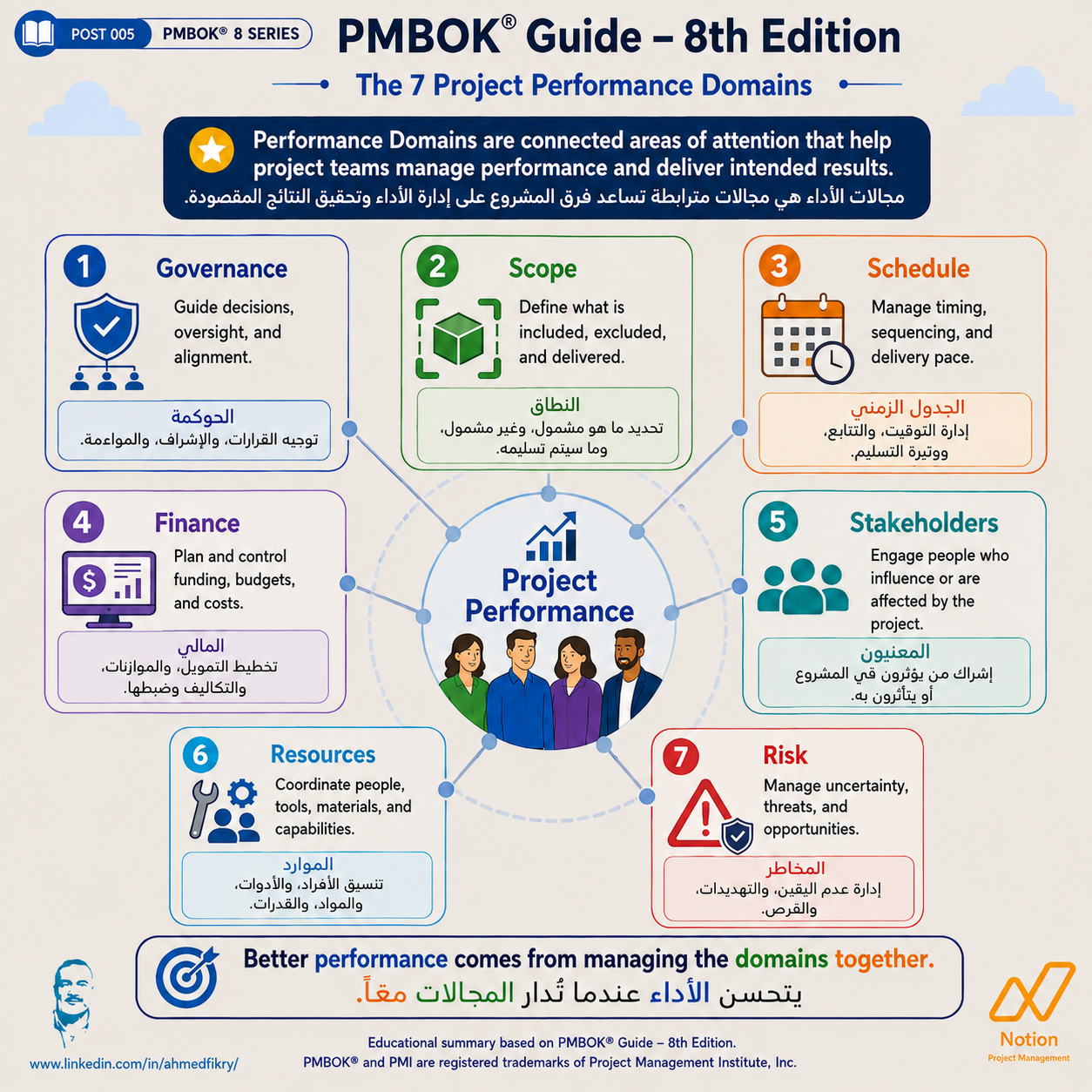
In the PMBOK® Guide – 8th Edition, the 7 Project Performance Domains provide a practical way to look at project performance from multiple angles.
They help project managers and teams think beyond isolated tasks and consider the broader areas that influence project success.
These domains are:
Governance. Governance provides the structure for decisions, oversight, and alignment. It helps ensure that the project remains connected to organizational direction, decision rights are clear, and accountability is maintained. Without effective governance, projects may move forward with unclear authority, weak escalation paths, or poor alignment with strategic priorities.
Scope. The Scope domain focuses on defining what is included, what is excluded, and what will be delivered. Clear scope management helps reduce ambiguity, align expectations, and protect the project team from unnecessary confusion or uncontrolled expansion of work.
Schedule. The Schedule domain addresses timing, sequencing, and delivery pace. It is not only about creating a timeline. It is about understanding how work flows, how activities depend on each other, and how the project team can manage delivery commitments realistically.
Finance. The Finance domain focuses on planning and controlling funding, budgets, and costs. Projects consume organizational resources, and financial discipline helps ensure that investment decisions, cost control, and value expectations remain visible throughout the project life cycle.
Stakeholders. The Stakeholders domain focuses on engaging people who influence the project or are affected by it. Project success depends heavily on understanding stakeholder needs, expectations, concerns, influence, and levels of engagement. Strong stakeholder management helps build alignment, trust, and support for project outcomes.
Resources. The Resources domain addresses the coordination of people, tools, materials, and capabilities. Even the best project plan cannot succeed without the right resources, skills, capacity, and working environment. Managing resources effectively supports both delivery performance and team effectiveness.
Risk. The Risk domain focuses on managing uncertainty, threats, and opportunities. Projects operate in changing environments. Risk management helps teams anticipate possible challenges, prepare responses, and identify opportunities that may improve project outcomes.
The key message is that these domains are not separate boxes to manage independently. They are connected areas of attention.
A decision in one domain can affect another. A scope change may affect schedule, cost, resources, stakeholders, and risk. Weak governance may affect decision speed, escalation, and value delivery. Poor stakeholder engagement may create resistance, delays, or unclear priorities.
This is why better project performance comes from managing the domains together.
The value of the Project Performance Domains is not in memorizing their names. Their real value is in using them as a practical lens to ask better questions:
Are our decisions aligned and well governed?
Is the scope clear and understood?
Is the schedule realistic and actively managed?
Are financial expectations visible?
Are stakeholders meaningfully engaged?
Do we have the right people, tools, and capabilities?
Are uncertainty, threats, and opportunities being managed proactively?
When project teams use these domains together, they create a stronger foundation for performance, delivery, and value realization.
إدارة أداء المشروع لا تتم من خلال بعد واحد فقط
في الدليل المعرفي لإدارة المشاريع الإصدار الثامن تقدم مجالات أداء المشروع السبعة عدسة عملية لفهم المجالات المترابطة التي تؤثر في نجاح المشروع
هذه المجالات هي
الحوكمة
النطاق
الجدول الزمني
المالي
المعنيون
الموارد
المخاطر
يساعد كل مجال فريق المشروع على التركيز على جانب مهم من الأداء
فالحوكمة تدعم القرارات والمواءمة
والنطاق يوضح ما سيتم تسليمه
والجدول الزمني يساعد على إدارة التوقيت ووتيرة التسليم
والمجال المالي يحافظ على وضوح التمويل والميزانيات والتكاليف
والمعنيون يضمنون إشراك الأطراف المؤثرة والمتأثرة
والموارد تنسق الأفراد والأدوات والمواد والقدرات
أما المخاطر فتساعد على إدارة عدم اليقين والتهديدات والفرص
والرسالة الأساسية هي أن هذه المجالات لا تدار بمعزل عن بعضها
فتغيير النطاق قد يؤثر في الجدول الزمني والتكلفة والموارد والمعنيين والمخاطر
وضعف الحوكمة قد يؤخر القرارات
وضعف إشراك المعنيين قد يقلل الدعم ويؤثر في تحقيق القيمة
يتحسن أداء المشروع عندما تدار هذه المجالات معا
Use the 7 Project Performance Domains as a practical checklist in your next project review: Which domain needs more attention today?
Disclaimer: This article is an independent educational summary and is not an official PMI publication or endorsement. PMI, PMBOK, and PMBOK® Guide are trademarks or registered trademarks of Project Management Institute, Inc.